Every rupee you spend on marketing should tell you something. Did it bring a click? A lead? A sale? If your campaigns can’t answer that question, you’re not doing performance marketing. You’re guessing with a budget.
Performance marketing flips traditional advertising on its head. Instead of paying for exposure and hoping for results, you pay for outcomes you can measure: a click, a sign-up, a download, a purchase. That single shift changes how businesses of every size plan, spend, and grow.
This guide breaks down performance marketing from the ground up, covering what it is, how it works, which channels matter, and how to build a strategy that actually moves your numbers. Whether you’re a solo freelancer running your first ad or a startup founder building out a marketing team, you’ll leave with a clear, practical understanding you can put to work today.
What Is Performance Marketing?
Performance marketing is a form of digital marketing where advertisers pay only when a specific, measurable action happens, a click, a lead, an app install, or a sale, rather than paying upfront for ad placement regardless of outcome.
This is different from traditional or brand marketing, where a company might pay a fixed fee for a billboard, a TV spot, or a print ad without any guarantee that it drives a single customer. With performance marketing, the cost is tied directly to results, making it a practical concept to understand if you’re wondering whether learning digital marketing is a good investment? Read our in-depth guide on Is a Digital Marketing Course Worth It in 2026?
Did You Know? The term “performance marketing” grew out of affiliate marketing in the late 1990s, when businesses first started paying partners a commission only after a sale was completed, one of the earliest pay-for-results models in advertising history.
How Performance Marketing Works
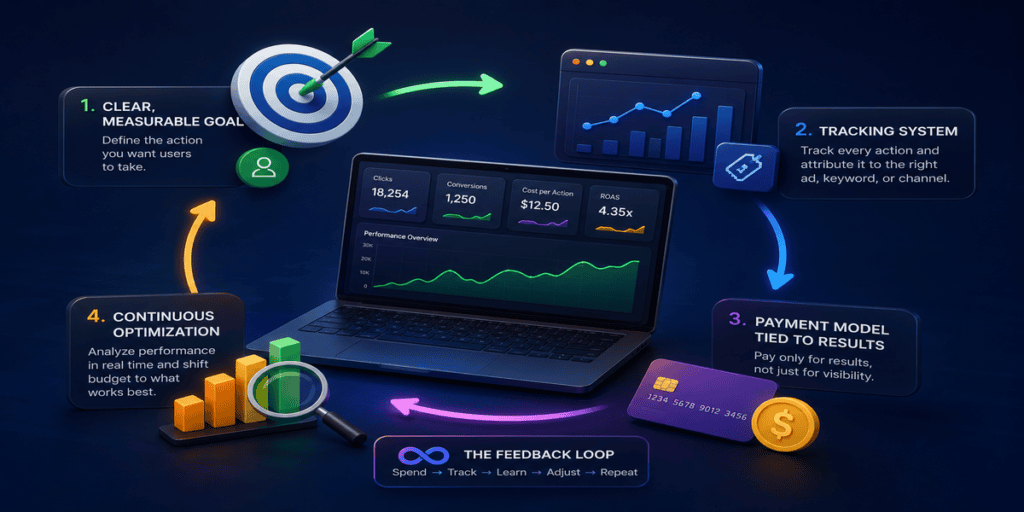
At its core, performance marketing runs on four connected pieces working together.
1. A clear, measurable goal. Every campaign starts with a defined action you want someone to take, such as buying a product, filling a form, installing an app, or subscribing to a newsletter.
2. A tracking system. Tools like Google Analytics, Meta Pixel, or dedicated conversion tracking software record when that action happens and trace it back to the exact ad, keyword, or channel that caused it.
3. A payment model tied to results. Instead of paying a flat rate, advertisers pay per click (CPC), per acquisition (CPA), per lead (CPL), or per thousand impressions with performance guarantees (vCPM in some cases).
4. Continuous optimization. Because every action is tracked, marketers can see in real time what’s working and shift budget toward the best-performing ads, audiences, and channels, often within hours, not months.
This feedback loop, spend, track, learn, adjust, is what separates performance marketing from traditional advertising. It rewards precision and punishes waste, because underperforming campaigns are visible immediately.
How Performance Marketing Works
At its core, performance marketing runs on four connected pieces working together.
1. A clear, measurable goal. Every campaign starts with a defined action you want someone to take, such as buying a product, filling a form, installing an app, or subscribing to a newsletter.
2. A tracking system. Tools like Google Analytics, Meta Pixel, or dedicated conversion tracking software record when that action happens and trace it back to the exact ad, keyword, or channel that caused it.
3. A payment model tied to results. Instead of paying a flat rate, advertisers pay per click (CPC), per acquisition (CPA), per lead (CPL), or per thousand impressions with performance guarantees (vCPM in some cases).
4. Continuous optimization. Because every action is tracked, marketers can see in real time what’s working and shift budget toward the best-performing ads, audiences, and channels, often within hours, not months.
This feedback loop, spend, track, learn, adjust, is what separates performance marketing from traditional advertising. It rewards precision and punishes waste, because underperforming campaigns are visible immediately.
Why Performance Marketing Matters in 2026
Marketing budgets are under more scrutiny than ever, and buyers now research extensively before making a decision, often across multiple devices and touchpoints. That combination makes performance marketing more relevant, not less.
A few reasons it matters right now:
- Budgets need to justify themselves. Finance teams increasingly expect marketing spend to show a direct line to revenue, not just brand awareness.
- Privacy changes have raised the bar on tracking. With third-party cookies fading and platforms tightening data-sharing rules, marketers who understand first-party data and proper conversion tracking have a real edge.
- AI-powered bidding has matured. Platforms like Google Ads and Meta Ads now use machine learning to optimize bids automatically, but they only work well when the underlying tracking and goals are set up correctly, which means understanding the fundamentals matters more, not less.
- Small businesses can compete with big brands. Because you only pay for results, a small business with a smart strategy can compete for the same customers as a much larger competitor, without matching their total ad spend.
Key Takeaway: Performance marketing isn’t a trend. It’s become the default expectation for how digital ad spend should be justified and measured.
Types of Performance Marketing
Performance marketing isn’t one single tactic. It’s an umbrella that covers several distinct approaches, each with its own payment model and use case.
Performance
Marketing
1. Affiliate Marketing
Businesses partner with affiliates (bloggers, influencers, review sites) who promote products and earn a commission for every sale or lead they generate.
2. Pay-Per-Click (PPC) Advertising
Advertisers bid on keywords or audiences and pay each time someone clicks their ad, typically on search engines or social platforms.
3. Cost-Per-Acquisition (CPA) Marketing
Payment is tied strictly to a completed action, such as a purchase or form submission, making it one of the lowest-risk models for advertisers. Unlike PPC Advertising, where advertisers pay for each click regardless of the outcome, this model charges only when a predefined conversion is achieved.
4. Social Media Advertising
Paid campaigns on platforms like Meta, LinkedIn, and TikTok, where targeting and measurement are built directly into the ad platform.
5. Native Advertising
Sponsored content that matches the look and feel of the platform it appears on, often priced on clicks or conversions rather than flat placement fees.
6. Email Marketing (Performance-Based)
Campaigns measured by open rates, click-through rates, and conversions, often optimized continuously based on subscriber behavior.
7. Search Engine Marketing (SEM)
Paid search campaigns designed to capture high-intent users actively searching for a product or solution.
Top Performance Marketing Channels
Choosing the right channel depends on your audience, budget, and goals. Here’s how the major platforms compare.
| Channel | Best For | Typical Pricing Model |
|---|---|---|
| Google Ads | Capturing high-intent search traffic | CPC, CPA |
| Meta Ads (Facebook/Instagram) | Broad targeting, retargeting, visual products | CPC, CPM, CPA |
| LinkedIn Ads | B2B lead generation | CPC, CPL |
| TikTok Ads | Reaching younger, engagement-driven audiences | CPC, CPM |
| Amazon Ads | Driving product sales on-platform | CPC, ACoS-based |
| Affiliate Networks | Extending reach through trusted third parties | Commission-based (CPA) |
Each platform has its own strengths, and most mature performance marketing strategies use two or three channels together rather than relying on just one.
Pro Tip: Start with one channel where your audience is most active, master its tracking and optimization, and only then expand to a second channel. Spreading a small budget across five platforms at once usually produces weak data everywhere instead of strong results anywhere.
Performance Marketing vs Digital Marketing
These terms are often used interchangeably, but they aren’t the same thing. Performance marketing is a subset of digital marketing, focused specifically on measurable, results-based campaigns.
| Aspect | Performance Marketing | Digital Marketing |
|---|---|---|
| Primary Goal | Measurable actions (clicks, leads, sales) | Broad brand presence and awareness |
| Payment Model | Pay per result (CPC, CPA, CPL) | Often flat fees or fixed budgets |
| Examples | PPC, affiliate marketing, retargeting | SEO, content marketing, branding, PR |
| Measurability | Highly measurable, real-time | Harder to attribute directly to revenue |
| Time Horizon | Short-to-medium term results | Long-term brand building |
In practice, the strongest marketing strategies use both: digital marketing (like SEO and content) builds long-term visibility and trust, while performance marketing drives immediate, trackable action on top of that foundation.
Benefits of Performance Marketing
- Measurable ROI. Every rupee spent can be traced to a specific outcome, making it easier to justify and optimize budgets.
- Lower financial risk. Since payment is often tied to results, you’re not paying for ads that don’t perform.
- Real-time optimization. Campaigns can be adjusted within hours based on live performance data, not weeks after a report is compiled.
- Scalability. Once a campaign proves profitable, budget can be increased with reasonable confidence in the outcome.
- Precise targeting. Platforms allow granular audience targeting based on behavior, interests, location, and intent.
- Accountability. Marketing teams and agencies can show clear, data-backed proof of the value they’re delivering.
Challenges and Common Mistakes
Performance marketing rewards precision, which means small mistakes can quietly drain a budget.
Common Mistakes Box
- Tracking not set up properly before launching a campaign, making optimization impossible.
- Optimizing for clicks instead of conversions, which drives traffic but not revenue.
- Ignoring the full funnel and only focusing on the first click, not what happens after.
- Testing too many variables at once, making it impossible to know what actually caused a result.
- Underestimating attribution complexity, especially when customers interact with multiple channels before converting.
- Chasing vanity metrics like impressions or reach instead of metrics tied to business outcomes.
Beyond execution mistakes, performance marketing faces structural challenges too: rising ad costs in competitive industries, increasing privacy restrictions that limit tracking precision, and platform algorithm changes that can shift results without warning. A resilient strategy accounts for these realities rather than assuming today’s setup will work unchanged forever.
Performance Marketing Funnel Explained
Performance marketing typically follows a funnel structure, where each stage has its own goals and metrics.
1. Awareness: Introducing your brand or product to a relevant audience through ads, content, or social posts.
2. Interest: Encouraging people to learn more, often through clicks to a landing page or content piece.
3. Consideration: Nurturing interested users with retargeting ads, comparisons, or testimonials that address hesitation.
4. Conversion: The moment a user takes the desired action: a purchase, sign-up, or lead form submission.
5. Retention: Using performance marketing tactics like email and retargeting to bring customers back for repeat purchases.
Think of the funnel like a real-world sales process: a shopkeeper doesn't expect someone browsing the window display to buy immediately. They engage the visitor, answer questions, build trust, and only then close the sale. The funnel simply maps that same journey to digital channels, with the added advantage that every step can be measured.
Key Performance Marketing Metrics & KPIs
Show Image A performance marketing analytics dashboard showing key metrics and KPIs
You can't optimize what you don't measure. These are the metrics that matter most.
| Metric | What It Measures | Why It Matters |
|---|---|---|
| CTR (Click-Through Rate) | % of people who click your ad after seeing it | Indicates ad relevance and appeal |
| CPC (Cost Per Click) | Average cost for each click | Helps control spend efficiency |
| CPA (Cost Per Acquisition) | Cost to acquire one customer or lead | Core profitability metric |
| Conversion Rate | % of visitors who complete the desired action | Reflects landing page and offer effectiveness |
| ROAS (Return on Ad Spend) | Revenue generated per rupee spent on ads | Direct measure of campaign profitability |
| CLTV (Customer Lifetime Value) | Total revenue expected from a customer over time | Helps determine sustainable acquisition costs |
| CPL (Cost Per Lead) | Cost to generate one qualified lead | Key for B2B and service-based businesses |
Key Takeaway: No single metric tells the whole story. CTR without conversion rate can be misleading, and CPA without CLTV can make a profitable campaign look unprofitable. Always view metrics together, not in isolation.
Best Performance Marketing Tools
Show Image A desktop computer set up with performance marketing tools and software
- Google Ads: The largest search advertising platform, ideal for capturing intent-driven traffic.
- Meta Ads Manager: Comprehensive targeting and creative tools for Facebook and Instagram campaigns.
- Google Analytics: Tracks user behavior and attributes conversions across channels.
- SEMrush / Ahrefs: Useful for competitor research and keyword-driven campaign planning.
- HubSpot: Combines CRM with marketing automation for lead tracking and nurturing.
- Hotjar: Provides heatmaps and session recordings to understand on-page user behavior.
- Zapier: Connects marketing tools together to automate lead handoffs and reporting.
Pro Tip: Before adding a new tool, make sure your core tracking (analytics and conversion pixels) is airtight. Extra tools can't fix a foundation built on inaccurate data.
Step-by-Step Guide to Creating a Performance Marketing Strategy
Show Image A marketing team presenting a step-by-step performance marketing strategy
Step 1: Define a specific, measurable goal. Decide exactly what "success" looks like, such as a number of leads, a sales target, or a cost-per-acquisition ceiling.
Step 2: Identify your target audience. Build a clear picture of who you're trying to reach: their demographics, interests, and where they spend time online.
Step 3: Choose the right channel(s). Match your audience and goal to the platform best suited for it. Search intent favors Google Ads, visual products often favor Meta or TikTok.
Step 4: Set up proper tracking before launch. Install and test conversion tracking, pixels, and analytics goals before spending a single rupee on ads.
Step 5: Create the campaign and ad creative. Write clear, benefit-focused ad copy and design creative that speaks directly to your target audience's needs.
Step 6: Launch with a controlled test budget. Start small, gather data, and avoid scaling spend until you have enough conversions to trust the results.
Step 7: Monitor performance and optimize. Review metrics regularly, pause underperforming ads, and shift budget toward what's working.
Step 8: Scale gradually. Increase budget incrementally on proven campaigns, watching for performance dips as spend rises.
Checklist: Before You Launch
- Goal clearly defined and measurable
- Target audience researched and documented
- Conversion tracking tested and confirmed working
- Landing page optimized for the offer
- Budget and bidding strategy set
- Reporting dashboard ready to monitor results
Real-World Performance Marketing Examples
Show Image A small business owner running performance marketing campaigns from a laptop
E-commerce retargeting: An online clothing store runs Meta Ads retargeting campaigns targeting users who viewed a product but didn't purchase, offering a small incentive to complete the sale, a classic CPA-driven tactic that recovers otherwise lost revenue.
SaaS lead generation: A software company uses LinkedIn Ads to target decision-makers at mid-size companies, paying per qualified lead generated through a gated demo request form.
Affiliate partnerships: A skincare brand partners with beauty bloggers who earn a commission for every sale made through their unique referral link, extending reach without upfront advertising cost.
Local service business: A home-repair company uses Google Ads to target "near me" search queries, paying per click but tracking every call and form submission back to the exact keyword that generated it.
These examples share a common thread: each ties spend directly to a specific, trackable outcome rather than general visibility.
Emerging Trends in Performance Marketing (2026)
- AI-driven campaign optimization. Platforms increasingly use machine learning to automatically adjust bids, audiences, and creative in real time based on performance signals.
- First-party data strategies. As third-party cookies phase out further, businesses are investing more in owned data, email lists, CRM data, and loyalty programs, to power targeting and retargeting.
- Creative-led performance. With automated bidding handling much of the optimization, ad creative quality has become one of the biggest remaining differentiators between campaigns.
- Cross-channel attribution tools. As customer journeys span more touchpoints, marketers are relying more on multi-touch attribution models instead of last-click reporting.
- Retail media networks. Platforms like Amazon Ads and other e-commerce marketplaces continue to grow as advertisers chase high-intent shoppers closer to the point of purchase.
Did You Know? Many performance marketers now treat creative testing itself as a measurable, iterative process, running structured variations of ad copy and visuals the same way developers run A/B tests on a website.
Conclusion
Performance marketing gives you something traditional advertising can't: proof. Every click, lead, and sale is tracked back to the exact campaign that caused it, so you know precisely what's working and what isn't, and you can adjust before wasting more budget.
That's the real value of performance marketing. It turns marketing from a cost you hope pays off into a channel you can measure, test, and improve with confidence.
Key takeaways:
- Performance marketing pays for outcomes (clicks, leads, or sales), not just exposure.
- Set up conversion tracking correctly before you spend a single rupee.
- Judge success using CPA, ROAS, and CLTV together, not any single metric alone.
- Start with one channel, test small, and scale only what's proven.
No two businesses see identical results, and no strategy works perfectly on the first try. What matters is building on real data instead of guesswork. Pick one channel, launch a small test campaign, and let the results guide your next move. That's how a reliable performance marketing strategy is built, one measurable step at a time.